
- National Cash Register History
- Old Cash Registers What Are They Worth
- National Cash Register Serial Numbers
- 711 National Cash Register History
National Accounting-Bookkeeping Machines may be secured by essential industries through priorities A stock of modern used National Cash Registers is also available for business needs. The National Cash Register Company. CASH REGISTERS. ACCOUNTING – BOOKKEEPING MACHINES. 40 ROCKEFELLER PLAZA, CIrcle 5-6300. 321 EAST 149TH STREET, MOtt.
- For more than a century (1905-2007), Bishop's Busy Big Store was the focus for both business and social events on the main street of Elizabeth, Illinois, with this solid brass, hand-cranked National Cash Register always on prominent display.
- National Cash Register Company After reading a description of the cash register designed by Ritty and sold by the National Manufacturing Company, John H. Patterson decided to buy both the company and the patent. He renamed the company the National Cash Register Company in 1884.
The cash register was invented in 1879 by James Ritty, a saloon owner in Dayton, Ohio. He produced the Incorruptible Cashier by modeling its inner workings after a device that was used to count the spins of an ocean liner's propeller in the engine room. The first cash register had metal keys that were embossed with denominations to mark the amount of sale and a bell to indicate that the register was ready to receive the cash.
The rights to Ritty's invention were purchased by Jacob H. Eckert, and then again by John H. Patterson. Patterson, who was a partner in the National Manufacturing Company, bought out his fellow investors and renamed the company the National Cash Register Company. His business became one of the leading manufacturers of cash registers of the 20th century. Today, the National Cash Register Company is known as NCR Corporation. They continue to manufacture modern electronic cash registers and computerized financial systems for businesses.
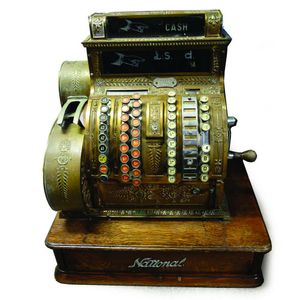
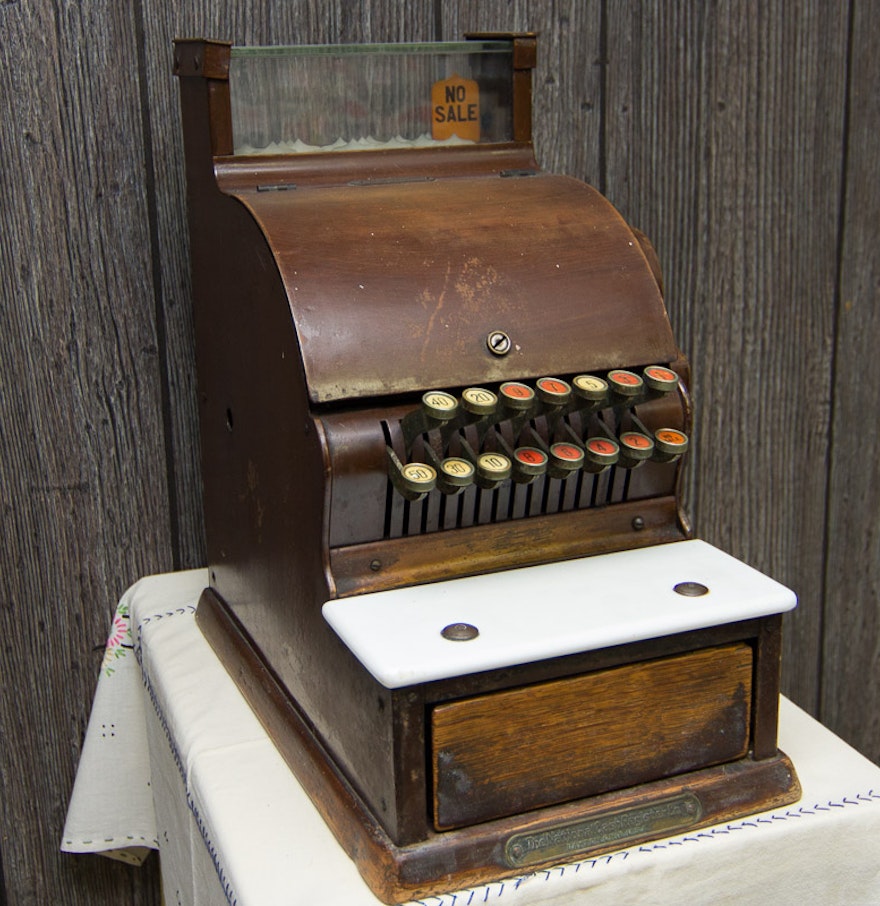
NCR antique cash registers are highly desirable to collectors today. They were manufactured with ornate designs on the outsides in brass, bronze, and nickel plate. These registers were also clearly marked with serial numbers, making them easy to date. Only two other cash register companies survived to manufacture registers in the 20th century: Ideal and Michigan.
Quick Facts

- One method John H. Patterson used to grow his business was to buy up smaller cash register companies to eliminate the competition. He was convicted of violating anti-trust laws in the 1910s. This is one of the main reasons other cash register companies did not survive
- The most collectible NCR registers include series 500 machines which were used by department stores and registers with a DR key, or dining room key, that were used by hotels
- NCR cash registers in excellent working condition usually sell for over $2,000. The oldest models from the 1880s can sell for as high as $15,000
_for_Fort_Worth_Music_Store%2C_Museum_of_Making_Music.jpg "National cash register company")
This photograph depicts the assembly department of the National Cash Register Company in Dayton, Ohio, circa 1930s-1940s. |
National Cash Register History
In 1884, John Henry Patterson bought out his fellow investors in the National Manufacturing Company and formed the National Cash Register Company, the predecessor of NCR Corporation. Located in Dayton, Ohio, this company made cash registers. The company grew slowly, producing only 16,000 registers in its first decade in operation. Through aggressive marketing and advertising, by 1914 the National Cash Register Company was producing 110,000 cash registers per year. In 1906, the company manufactured the first electric cash register.
Old Cash Registers What Are They Worth
Few cash registers were sold in the early years of the company’s operation due to lack of demand. However, Patterson was confident that once owners understood how the register reduced theft there would be an upsurge of demand. He created the American Selling Force, a committee within the company that would act as traveling salesmen. These workers were paid on commission, trained on a universal script, and sent on visits to other businesses to promote their product. The NCR also began buying smaller firms to form a monopoly. Patterson, as well as a few other NCR CEOs, was convicted in the mid-1910s of breaking the Sherman Anti-Trust law.
Patterson was well known for his compassion for his employees. He provided women workers with coffee and soup for lunch. Machine operators sat on actual chairs with backs for support rather than on stools. He provided his workers with indoor bathrooms. Patterson implemented a ventilation system to provide clean air to his workers. He also maintained a doctor's office in his factory to assist injured workers as quickly as possible.
The National Cash Register Company engaged in civic work as well. Following the Dayton flood of 1913, the company provided approximately $1 million to assist people in recovering from the disaster. The company allocated an additional $600,000 to study how the community could prevent flooding in the future. In addition to these efforts, Patterson donated money to help build parks and playgrounds. He also provided funds to create the first public kindergarten in Dayton.
Patterson died on May 2, 1922. His son, Frederick B. Patterson, assumed control of the National Cash Register Company. That same year, the company had officially produced two million cash registers. It also had begun producing other business machines. During World War I and World War II, the National Cash Register Company contributed to the United States' war effort by manufacturing shell fuses, plane engines, and code-breaking machines, among many other items.
During the 1950s and the 1960s, the National Cash Register Company began to produce computers. In 1974, it changed its name to NCR Corporation to symbolize its more diverse product line. In 1991, AT&T acquired the NCR Corporation but decided to end its control of NCR Corporation in 1997. In 2009, NCR Corporation announced the company’s move to Duluth, Georgia. NCR Corporation continues to operate, specializing in office equipment.
See Also
- [NCR History]
References
National Cash Register Serial Numbers
- Cashman, Sean. America in the Gilded Age. N.p.: NYU Press, 1993.
- Chandler, Alfred D., Jr. The Visible Hand: The Managerial Revolution in American Business. N.p.: Belknap Press, 1993.
- Murdock, Eugene. Buckeye Empire: An Illustrated History of Ohio Enterprise. N.p.: Windsol, 1988.
- Painter, Nell Irwin. Standing at Armageddon: A Grassroots History of the Progressive Era. N.p.: W.W. Norton, 2008.
- Porter, Glenn. The Rise of Big Business, 1860-1920. N.p.: Harlan Davidson, 2006.
711 National Cash Register History